new paintings, prints, reviews, and news.

Tuesday, October 15, 2024

Friday, October 11, 2024

Monday, October 7, 2024


Arbutus Trail is a painting completed in 2022 and depicts a path found at Lighthouse Park in North Vancouver. This Autumn scene shows splashes of yellow among the blues and greens in the trees. 

Click the image to buy a print in paper, canvas, wood, or acrylic.

email me if you have any questions: taraleeguild@gmail.com


Monday, March 23, 2015

I'm giving 15% off discount to everyone at my etsy shop! Just remember to put in coupon code THANKYOU at check out on https://www.etsy.com/shop/TaraleeGuildGallery

please click to see shop


Monday, January 6, 2014

Emily Carr #1 42x30 acrylic on canvas


This is based on two Emily Carr paintings spliced together and then smoothed out for a fluid composition. http://van-art.com.
1959 Streamline (2011) - 72x48 acrylic on canvas Taralee Guild

Tuesday, September 28, 2010

The Painter of Mediated Life: Judith Eisler

As a painter, I am very concerned about my chosen medium’s position in contemporary art. I often think about the effects of translation when using the internet, photographic and filmic imagery for my paintings. I’m equally interested how ideologies are constructed around an environment saturated with technologic mediation. It’s for these reasons that I find New York artist Judith Eisler’s photo-realistic paintings based on film especially meaningful. Eisler’s filmic paintings contribute to the post-modern movement of Photo-Realism and how it renegotiates the relationship between painting and the mechanical eye. Her cinematic photo-realism becomes a reconstruction of her identity, taste and desire. In doing this she’s both a product and a depicter of our zeitgeist, where the most potent visual information is experienced through simulation. Since the nineteenth century invention of photography pushed painting into Modernism, the two mediums have had a reactionary relationship. Two early Modernist painting efforts, Impressionism and Futurism, strongly relate to the work of Judith Eisler. Whether it was the artist’s attempt to capture light or the rapid movement of urban life, paramount was the desire to immortalize fleetingness into a fixed medium. Film, made up of light and movement, was also the closest approximation of life in real time. Wielding a remote control, Judith Eisler halts the progression of the film, the simulation of life, snapping a photo to take back to her studio. But as if stopping time came with consequences, the film image is fragmented from the full narrative and blurred by the television light. A further distortion is shown in Eisler’s oil painting Linda Manz (2009) where the upper forth of the composition is obscured by a horizontal streak unique to VCR pausing. (Fig. 1) This shows that when film, a medium reliant on the passage of time, is made static by Eisler also produces static from the technology.


Fig. 1 Judith Eisler, oil on canvas, 30x42 inches. Linda Manz (2009) Judith Eisler Homepage. March 26, 2010.


Photo-Realism’s beginnings were similar to the paintings shift to Modernism in that it was reactionary. Pop Art and Capitalist
Realism reacted to the sudden increase of advertisement’s scale and sophistication. The Post-WWII prosperity in the US brought many new products to the market in massive quantities from large scale factory production. To sell all these new goods in America, the newly available Freudian psychology was applied to ads, where practicality was replaced by products as vessels of consumer’s selfish desires and primitive emotions. (Curtis) Capitalist Realism was unique as its inventors had personal experience with even darker forces of propaganda. Gerhardt Richter was born into Nazi Germany, who, like is younger associate Sigmar Polke, later had to escape from Soviet occupied East Germany. (Honour 880, 882) In his painting series October 18, 1977 (1988) Richter metaphors his own suspicion of both the States official story and the dogma of the Red Army Faction, in that “…just as painting and photography were making competing demands from within the same object, so ideology’s claims were unresolvable.” (Hopkins 216)

Judith Eisler’s work is heavily influenced by Richter but also has her own reactionary relationship to technological innovation in her time, at a high point of television’s influence. The movies Network (1976) and Videodrome (1983) made some
direct and allegorical critiques of television’s mind control over the isolated masses while Noam Chomsky provided the theoretic framework in his influential book Manufacturing Consent: The Political Economy of the Mass Media (1988). Referencing this, Eisler’s painting Nikki Brand (2007) alludes to the critique where, in its own echoing simulacrum, Debbie Harry aka Blondie plays the role of Nikki Brand in Videodrome (1983). (Fig. 2) In the movie, the psychiatrist Nikki Brand criticizes TV over-stimulation and then plays muse to the hallucinations of James Woods character. (Videodrome) She encourages him in both the scene where he’s sucked into a sexualized television and the ending where, in a weird doubling of the character’s suicide, he first watches it on TV before mimicking it. (Videodrome) The video cassette, which became widely accessible in the late 70s, and television are crucial elements in the movie, just as they are in Eisler’s artistic practice.

Fig. 2 Judith Eisler, oil on canvas, 58x76 inches. Nikki Brand (2007) Judith Eisler Homepage. March 26, 2010.


Also in the late seventies, Rosalind Krauss and other contributors to the arts journal October start
ed to apply semiotic language to photography. (Hopkins 208) It would be heralded as an indexical sign, directly using imprints of reality, as opposed to the iconic sign of “…the painterly mark”. (208, 209) Photo-Realists like Richter and Eisler contradict these distinctions, as they mimic a camera by using techniques of extreme accuracy, whether slide projection for Richter, or grid transfer for Eisler. They “…take banal photographs and transmute them into something quite different… their indexical relationship to that photograph (has) a whiff of ‘the real.’” (Godfrey 253) Here, the painter is a mediator “…whose ‘performance’ – the mastery of the narrative code – may possibly be admired by never his ‘genius’. (Barthes 97)

Another change in the perception of photography was the re-photogra
phy from Douglas Crimp’s Picture’s Generation. Sherrie Levine’s After Walker Evans (1981) shows how the photo could displace authorship while deceiving the viewer with the medium’s transparency. (212) Eisler’s could be a better enacting of decentralized authorship, considering the longer line of translation: from acted scene, to film to VHS video to television to photo and finally to painting. Testament to Barthes’s “…birth of the viewer” for “…the death of the author”, each mediator, although the same image, has its own context, meaning, and behavior associated with it. (Barthes 100) Furthermore, in terms of transparency, Eisler painting surfaces have no obvious qualities of paint as the texture is smooth and glossy like a photo. But visual information is blurred, in grayscale or processed colour, and cropped, showing the opaque qualities of photography. Photo-realism renegotiates the critique as painting playacts an indexical role, while the mechanical eye is malfunctioning.

The Painting of Modern Life was a 2007 London exhibition at Hayward Gallery where Judith Eisler was grouped with all major Photo-Realists over the last 40 years including Vija Celmins, Malcom Morley, and Richard Hamilton. The title of the exhibition refers to Charles Baudelaire’s essay The Painter of Modern Life”(1863) where “…the poet called for a shift in s
ubject matter …away from the grand themes of myth and history, and towards the everyday activities of urban life.” (Foster) Baudelaire does not suggest using photography for this purpose because he “…remained suspicious of the new medium.” (Foster) Also, the text was fifteen years before the first successful use of quick shutter speed to capture movement, Eadweard Muybridge’s Galloping Horse (1878). (Honour 684) In this new exhibition the Photo-Realists centralized photography but only in the subservient role of a tool. This somewhat explains why Tony Godfrey found his photography students to hate the show, exclaiming that the paintings were "…a rip-off, theft even of the photographs!" (Godfrey 151) It’s an odd accusation from a mechanically reproducible medium, but in Eisler’s case, originality is very difficult to place. The real world events she depicts are in fact simulations: acted scenes of a movie or on stage rock star posturing. Since representational paintings usually depict life, they mistake “…signs of the real for the real itself”, a hyperreality. (Baudrillard 170)

Judith Eisler’s work in the gallery hung next to Johannes Kahrs’ two panel piece La Révolution Permanente (2000). (Fig. 3) They both work from photographs taken of a television playing movies, giving their images a special glow. Eisler and Kahrs could be seen as the next generation of Photo-Realist painters, instead using a time-based photographic subject. It complicates Photo-Realism because in the repetition the resource image skips a beat into a medium that is forever fixed. Since it was originally reliant on film to make sense, as information is revealed over time, the film still is especially inarticulate. But they’re replacing the experiential nature of film with paintings traditional aura and ritualistic consumption under the cult of beauty. (Benjamin 223, 224) If they ease into suspending their disbelief for illusionistic painting, viewers are trapped into a series of simulated lies, through many layers of mediators.

Fig. 3 Johannes Kahrs, oil on canvas, 76x106 inches La Révolution Permanente (2000) Johannes Kahrs: Contemporary Artists. March 26, 2010.


Eisler’s painting in the show Smoker (2003) was based on the second film by director Nagisa Oshima Cruel Story of Youth (1960). A kind of Japanese Rebel without a Cause (1955), it shows beautiful abject youth acting out mythic coolness. Just as another painting based on the thematically similar movie Dogs In Space (1986), the painting contains another layer of simulacra, this time in content, because “…what we view in the cinema is already a totally simulated reality where the humans conform to stereotypes …coded in the eclectic mixtures of movie genres and period styles.” (Newman 82)

Fig. 4 Judith Eisler, oil on canvas, 58x70 inches, Smoker (Cruel Story of Youth) (2003) The Painting of Modern Life, Hayward Gallery. March 26, 2010.

Smoker (2003) contains elements that relate to historic photography and advertisement, particularly in the way such mediated information affects real life behavior. The half-parted female lips, shows a sexy pose popular today which only exists because of photography. As some of the first photos were nude women, these early attempts at pornography depicted female figures standing awkwardly in utilitarian fashion. (Varma) The pornographic feminine sexuality was developed over time as real women learnt these new body gestures for the camera. (Varma) As if to further fetishize the glossy red lip
s, she’s smoking a cigarette. The Freudian connotations of this image are all too relevant when considering that it was Freud’s nephew Edward Bernays who deliberately popularized smoking to women. In the 1920s, his “Torches of Freedom” campaign had suffragette reminiscent women light up during a well publicized stunt. (Curtis) By connecting women smoking to women’s lib, Bernays aka The Father of Public Relations, single-handedly overturned the taboo against women smoking. (Curtis) Since then, women smoking cigarettes has been promoted extensively in film as advertising ploys to “…influence young girl’s attitudes towards the habit.” (Escamilla 412) Real identities of young impressionable viewers are replaced by manufactured roles. This shows the way Eisler’s content can displace authorship, truth and the real.
As seen with her attraction to using films that voyeur young outsiders and pop rock stars, it appears Eisler uses these images more subjectively, creating a fragmented self-portrait. The films used for the paintings are from the sixties to mid-eighties which roughly parallels Eisler’s birth in 1962 into her early twenties. Now older, it’s as if she uses the filmic archive to reconstruct identity, tastes and desires. But her voice and the content she expre
sses are limited to pre-existing cinematic tropes, in some ways similar to Cindy Sherman’s Untitled Film Stills which began in 1977. Eisler chronicles herself as a product of a generation raised on television, where everything learnt and internalized was emitted from the tube.

Judith Eisler applied the methodology of Photo-Realism to technology she grew up with, choosing content that showed aspects of her ideological make-up. She also has e
volved beyond VCR and television, two dying technologies, in a small series based on Johnny Thunders. Deriving several images from the more contemporary phenomena of the internet, she showed several colour distortions produced by converting You Tube videos. This shows the potential associations Photo-Realism can make with newer technology. Eisler takes up the discourse between photography and painting and expands it to film, making the issue of time part of the discourse. A painter of mediated life, Judith Eisler is all too relevant in the contemporary atmosphere. The desire to capture fleetingness within a fixed medium makes reference to the mood at the birth of Modernist painting. But the displacement of authorship, originality, truth, and the real are all relatively new issues to explore in painting. This pressure on the expectations and definitions of the medium gives painters some breathing room and space to move forward.

Work Cited
Barthes, Roland. “The Death of the Author” Auteurs and Authorship. Ed. Barry Keith Grant. Malden, MA: Blackwell Publishing, 2008. 97-100.
Baudrillard, Jean. “Simulacra and Simulations” Jean Baudrillard Selected Writings. 2nd Edition. Ed. Mark Poster. California: Stanford University Press, 2001. 169-187.
Benjamin, Walter. “The Work of Art in the Age of Mechanical Reproduction.” Illuminations. Ed. Hannah Arendt New York: Schocken Books, 1969. 217-251.
Curtis, Adam. The Century of The Self, Part One: Happiness Machines. Dir. Adam Curtis. BBC Four, United Kingdom. 2002.
Escamilla G. and A. L. Cradock. “Women and Smoking in Hollywood Movies: A Content Analysis.” American Journal of Public Health. vol. 90 No. 3. March 2000. 412-414.
Foster, Hal. "At the Hayward." London Review of Books 29.21 (2007): 16. 15 Mar. 2010 .
Godfrey, Tony. “The Painting of Modern Life”. Photography & Culture vol. 1 no. 2 November 2008: 251-253.
Honour, Hugh and John Fleming. The Visual Arts: A History. 7th edition. Ed. Sarah Touborg. New Jersey: Pearson Education Inc., 2005.
Hopkins, David. After Modern Art 1945-2000. New York: Oxford University Press, 2000.
Newman, Michael. “Simulacra” Appropriation. Ed. David Evans. London: MIT Press/Whitechapel Gallery, 2009. 82.
Varma, Dev. “The Mechanical Eye: The Photograph.” Pornography: The Secret History of Civilization. Dir. Dev Varma. Channel Four Television, Great Britain, 2006.
Videodrome. Writ. / Dir. David Cronenberg. Prod. Claude Héroux. Canadian Film Development Corporation, 1983.

Tuesday, March 23, 2010

Exhibition Review: Geoffrey Farmer The Surgeon and the Photographer

Exhibition Review: Geoffrey Farmer The Surgeon and the Photographer


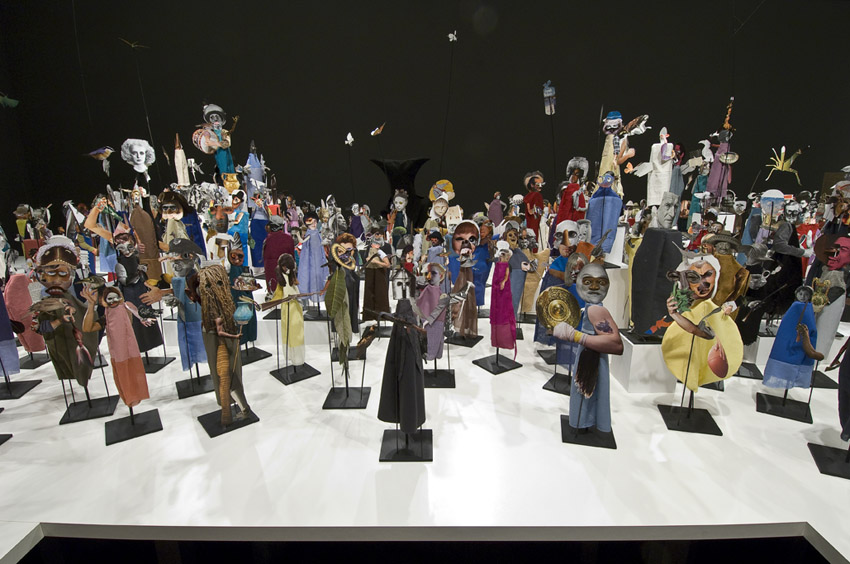
Emily Carr 1992 graduate, Geoffrey Farmer exhibited The Surgeon and the Photographer at Catriona Jeffries Art Gallery from January 29th to March 6th, 2010. The show consisted of an army of cut-and-paste figures also known as The Last Two Million Years. There was also 2 filmic pieces that had to do with similar content, one being a computer controlled montage which used images from Life Magazine.


The title references Walter Benjamin’s essay The Work of Art in the Age of Mechanical Reproduction (1935). The two paragraphs from that text involve a comparison of a painter and a cameraman within a corresponding analogy of a magician and a surgeon. He tries to point out that a cameraman is closer in proximity to reality than a painter, despite the obvious problem that his reality is always filtered through a machine. With the critique of painting and the promotion of cinematic film aside, Benjamin’s states that “…the cameraman consists of multiple fragments which are assembled under a new law.” (Benjamin) This “new law” could refer to the specific methodology of creating each of the 365 pieces in the show and this assemblage will always be somewhat fragmentary in nature. The exhibition title calls up images of the collage process, where material is cut with precision, much like a surgery, and that material was offered up by a camera as it is mostly photographic.


But each piece also uses cloth and is put into a 3 dimensional arrangement. This is an unconventional outcome for a collage and creates a dialogue between it and another medium, sculpture. The problem of translation makes this relationship especially interesting since the photographic print bits remain 2D within this new 3D art form. Each flimsy seemingly temporary structure, often with its scotch-tape exposed, is put together on black bases with supporting posts which are uniform throughout the show.


With white pedestals at various heights and a non-linear organization of the figures, the show supposedly incorporates the non-hierarchical presentation technique by Aby Warburg's Mnemosyne Atlas. This becomes a way for Farmer to intellectually forfeit the authoritarian role over the installation. Of course, this is assuming we forget the problematic setting of the white cube and that Geoffrey needed to maintain a constant number of pieces to use the framework of a typical calendar year. In the original, Aby Warburg’s own subject position was expressed through his endless work as “…he searches for the proper arrangement of his fragmentary universe.” (Dillon) The comparison offered by the exhibition is not entirely useful as Warburg’s memory map would have been more malleable as he journeys through time and space. One table in the exhibition is in direct contradiction to this idea, where the central group carries long flag-like posts unlike the outer figures on the edges, making it appear aesthetically dictated.

Warburg was also an early researcher of the Native American Hopi, whose Kachina dolls bare a resemblance to these sculptures by Farmer. However, these new dolls do not carry dogmatic symbolic meaning or ceremonial purpose (unless we consider art gallery attendance a purposeful ceremony). Instead they seem to be a chaotic arrangement of a collective memory in limited availability as it’s expressed through printed photographic material.


Bibliography


Benjamin, Walter, "The Work of Art in the Age of Mechanical Reproduction” Illuminations Ed. Hannah Arendt. New York: Schocken Books, 1968. 217-251


Dillon, Brian. “Collected Works: Aby Warburg's Mnemosyne Atlas”. Frieze. Issue 80, January-February 2004


Tuesday, February 9, 2010

Exhibition Review: An Invitation to An Infiltration at the CAG


The group exhibition An Invitation to An Infiltration is currently being held at the Contemporary Art Gallery, running from January 21st to February 28th, 2010. The show was put together by visiting curator Eric Fredericksen who is director of the art space Western Bridge in Seattle, Washington. It included artists at various stages of their career, from local and abroad, such as: Hadley+Maxwell, Jordan Wolfson, Dexter Sinister, Jonathan Middleton, Fia Backström, Holly Ward, and Lucy Clout.

In justifying the show and explaining his inspiration, Fredericksen references Andrea Fraser’s writing on the institutionalization of Institutional Critique. It has become no longer shocking or radical to challenge, deconstruct or bring attention to the white cube, the sterile gallery space and the bureaucracy around it, and in some ways it’s to be expected in contemporary art. An Invitation to An Infiltration hoped to re-hatch and disrupt the discourse once again.

To do this the show is meant to change over time through the process of various artistic interventions – as if an ongoing performance, or a malleable installation. This state of flux affects the titles, format and placement of artworks. Also, entirely new works can be added. Rather comically, the title of the entire exhibition is being debated between the curator and an artist. The show mandate challenges the assumption that art objects are meant to hold still, being captive by the audience and institution around it. The fact such a volatile entity is a group show means that An Invitation to An Infiltration is a set of ongoing negotiations. The show utilizes not only the interior of CAG but the outside and the text, paraphernalia, and discussions around the show.

Lucy Clout’s piece Untitled (eyebrows) (2008), a painted grey board of MDF is displayed suspended at eye level, therefore limiting the viewer’s view. At one point the work was installed in front of the reception desk, making it hard to normally interact with the gallery attendant. In ducking under to avoid the obstruction, the viewer would find themselves uncomfortably close. The artist Jonathan Middleton shows a proposal that the exhibition title be changed to: “Strange. The first time I’ve heard of a piano with four legs… (Hey, I keep falling down!)”. Dexter Sinister created various wood objects with use value like a shelf, twin lecterns and a sandwich board. Some other props were less clearly defined, but were meant to be eventually put to use. With this work, Sinister plays with the old Kantian definition that art has no function. In a related sculptural work, Hadley+Maxwell erected a marble pedestal with nothing on it.

A private performance by Hadley references the difficulty in critiquing the show. Dressed as a male 18th century art critic, she went through the show interacting with the artwork either with passive detachment or violence. In experiencing any of these works in their current but temporary state, makes the whole thing seem unsettled. This art is set up to be continually in the act of turning, making it impossible to be pinned down to any one interpretation. However, this could be a useful way to read art as it takes into account the ever changing context of time and space. It underscores that the comforting idea of fixed meaning or universal truth is a myth.

Exhibition Review - Backstory: Nuuchannulth Ceremonial Curtains


Backstory: Nuuchannulth Ceremonial Curtains and the Work of Ki-ke-in is a current Cultural Olympiad exhibition at the Belkin Art Gallery running from January 17th to March 28th, curated by Charlotte Townsend-Gault of UBC. The show focused on the thliitsapilthim, which are large ceremonial curtains painted to signify the family ancestry of the owner. These were displayed on the walls in the largest room which also held a glass case showing a carved mask and an intricately woven basket. The right side of the main room displayed some smaller fabric robes and partitioned off several video viewing stations for films, documentaries and interviews. Most work was accompanied with a textual “backstory” about the piece and the owners. This literature ranged from conversational personal narratives, notes from the artist and/or an objective formal history. In the smaller space to the right of the gallery entrance showed many framed and greatly detailed drawings by i-e-in. Also along this wall were display cases that held mementos, personal photographs, and a collection of carved and painted whistles.

Several curtains by unknown artists were older, from the 19th century, which were notably different from the more contemporary featured paintings of i-e-in (Ron Hamilton) of the Nuuchaanulth in the same show. Historically, these older pieces were produced post-European contact, which occurred in 1778. Therefore the stylistic difference does not denote any assumed “purity” or “authenticity” of culture. In fact, the older curtains were less typical looking for what we now expect of First Nation’s design. One noteworthy example was a very long curtain (71x892 cm) that ran the entire northern wall entitled Kwaayats’iik (All Wolves) (c. 1900). This shows a line of 11 loosely rendered wolves formatted to appear life-size, each with a distinct body decorative pattern and colour.

Thluut’otl Aytsaksuu-ilthim (c. 1880) by an unknown artist was another painting of an early and uniquely executed curtain. The empty space around the objects and figuration is unusual because there still appears to be an implied pictorial depth. There are only two colours blue and iron oxide red used to describe, in a semiotic simplicity, the narrative and symbology of a coming of age potlatch ceremony for a girl named Effie Tate. The word Aytsaksuu-ilthim is defined in the exhibition catalog as a “…girl’s moveable puberty curtain”. The swing is symbolic for her transition from girlhood to womanhood. On the right there is two feast bowls fashioned as small war boats and the fins and meat of a whale is throughout the foreground.

The newer thliitsapilthim where predominately painted by the featured contemporary artist, i-e-in aka Ron Hamilton. When compared to the 19th century paintings, Ki-ke-in’s aesthetic seems very polished. One possible reason for this could be that the semiotics and general style of aboriginal design solidified and became more deliberate to provide a strong binary to Canada’s Eurocentric art. It would be important to note that the older curtains were made before the total impact of reservation schools, the Indian Act (1885) and other National governmental policies to destroy the language and culture of First Nations people was felt. More stylistic variation was possible before and it was more likely that amateur painter’s designed the thliitsapilthim. First Nation’s cultural contributors and artists like Ron Hamilton would be working under new pressures coupled with the influential European myth of the genius painter, and the general idea that an individual stuck to, and therefore became an expert at, only one discipline.

Ron Hamilton’s 20th century thliitsapilthims have a strong graphic quality, which would make them translate to print or silkscreen very easily, as shown in his Naakshuu-isks Thliitsapilthim (1993) and several others. For comparison, Chachimin Aytsaksuu-ilthim (c. 1850) by unknown has black paint dry-brush dabbing for the bird feathers and interiors of the animals. Much of the older pieces had painterly edges and suggestions of spatial depth like the overlapping in Chachimin Aytsaksuu-ilthim (c. 1850) or the implied foreground/background depth in Thluut’otl Aytsaksuu-ilthim (c. 1880). Ron Hamilton’s hard edge designs were very flat with no illusion of space. However these were the biggest and most impressive curtains of the show, particularly the huge monochrome entitled Nuukmiis Thliitsapilthim (1989) that described in saturated black paint a thunderbird, whale and raven.

However, i-e-in aka Ron Hamilton was capable of painting illusionary pictorial space as illustrated by Yaalthuu-a Thliitsapilthim (1984-85). The bottom third of the painting consists of realistically rendered mountains in the distance emerging from the water which holds 2 occupied boats. The above central figure called a thunderbird had wings that were more realistically molded, but for the most part the larger graphic style figures look superimposed over the more traditional European-looking landscape. The lack of unity isn’t disappointing because its rather daring to attempt the fusion and the effort is commendable. This hybrid form of contemporary art by First Nations is welcomed in Vancouver’s art community as it fits in with Brian Jungen and Lawrence Yuxweluptun.


Saturday, September 5, 2009

Airstream solo show


Airstream - solo painting exhibition by Taralee Guild

OPENING Friday September 11th at 7pm during Swarm @ JEM Gallery, 36-22 East Cordova St. Vancouver, BC.

This exhibition is comprised of 20 realistic paintings of early model Airstream trailers which have been polished to a mirror finish. Each composition emphasizes the distortion visible in the highly reflective metal. The paintings were inspired from amateur photographs taken by proud Airstream enthusiasts or sellers on the internet. The series examines the politics of the reflection and uses it to metaphor the ideology of the American Dream.

Taralee Guild lives and works in Vancouver, BC. Her painting praxis explores simulacrum of filmic/photographic media and where realism backslides into non-communication. She will be receiving a BFA of Visual Arts from Emily Carr University in April 2010.

JEM Gallery

36-22 East Cordova Street,

Vancouver, BC, V6A 4G8

http://www.facebook.com/thejemgallery

http://taraleeguild.com

g_taralee@hotmail.com

Saturday, February 21, 2009

So much has happened!


-----------------------------------------------------------------------------------------------
Since The Cheaper Show I've done Bikosphere
at Centre A, the "Buy More Art" student sale at ECU, a group show Nomadic Convergence at the Concourse Gallery, and a couple of group shows at student ran gallery The Brow.

I finally had my own solo show Mechanical Abstraction at The Brow. That went over extremely well and I'm ready to do more.

Starting in March I'm renting my very own studio space downtown. That means when schools out I can still work in a studio space all summer. Exciting!

Sunday, June 22, 2008

Buy Art, Not Cocaine: The Cheaper Show 8

Saturday June 21st was The Cheaper Show No. 8.

I found out about the show in the free paper my partner handed me. It sounded like a good premise, evening the playing field and I looked it up to submit. I put in Multiples, Heroic Strains, and Roller-skates. They loved the pin up girls but said that Heroic Strains was less refined. I was very surprised to find I got in, after not hearing from them for so long. I painted 2 paintings special for the show, and put them in the Roller-skates. They put in the skates, and it sold. I’m glad to get the other two paintings back – I didn’t photo doc them!

There was a line when I arrived at 9. It went around the block. I was meeting a friend there, and we got in right away because I was an artist. There was a DJ, we had beer and looked at all the art. It was great. As the night moved it got really crowded and hot in there. I couldn’t believe so many were there because of art. There’s a special feeling in going to art events. This was the best art sale show I’ve ever been in. I’ll be looking forward to the next one.

Attilla Richard Lukacs was supposed to be in that show, I couldn’t find his work. Adam Dodd was too, I own a drawing of his I bought at the Gaff Gallery that’s now closed. I found Robert Mearns crotch shot figure, that was his only piece in the show. These are artists I’m looking at, as they are part of the Vancouver art scene. I won’t consider them my peers until I have a few solo shows here.


Saturday, June 21, 2008

Elizabeth McIntosh at Blanket Gallery:


pyramidal enigma

Elizabeth McIntosh’s latest paintings are large crystalline candy. Playfully coloured, these deliberately clumsy geometric compositions illuminate outward from the gallery wall. However the imposing scale of mostly 75” by 90”, takes on the smothering seriousness known to mid-20th century abstraction. She wants the viewers to be transformed. Like a contemporary Rothko, her paintings are vessels of self-realization without the baggage of lofty semi-religious experience and universal primitive emotion. These new painting’s physical presence, vibrancy, and non-illusionary flatness would certainly hold up such transcendental potentiality.

McIntosh’s current exhibition at Blanket Gallery in Vancouver is only her second solo show and includes six oil paintings and one framed collage. The impressive paintings fill up the modest space. The installation made categorical sense with the three large 75” x 90” paintings on west wall, three smaller 30” x 40” paintings on east wall, and the single framed collage on the south wall.

Untitled (multi-coloured vertical stripes) (2007) brings to mind non-figurative Orphism of Sonia Delaunay. But instead of concentric circles, these large colorful structures are nearly entirely built up with triangles. There is a push-pull of positive and negative shape, as viewing breath in and out between triangles of rich colour and washed charcoal black. This is the kind of viewer experience that non-representational painting has to offer. Instead of being relaxed and satisfied by what the painting is of, the mind is at state of activity trying to make sense of these new and fascinating objects.

These works are designed like a do-it-yourself Hard-Edge Abstraction painting. It’s easy to feel how process oriented her practice is. Untitled (silver with geodesic shapes over colour) (2008) and Untitled (negative black triangles on silver ground) (2008) show repetition of triangles over on metallic silver paint. There is an obsessive one after the other placement but controlled with a knowledgeable restraint for the composition. The other two 30” by 40” works named Untitled are painted with saturated, bright and even neon colour applied much thicker than the rest of those exhibited. These works take on the appearance of unfolded origami. But even under the gaze of the most analytical eye, the structures always unravel back to its original position for new and infinite combinations.

The bright and sunny piece called Untitled (yellow) (2007) shows off the painterly brushstroke common throughout. Even though these are on canvas, the slightly transparent and directional paint application gives the impression of wood grain. This tactility becomes one of the ways McIntosh naturalizes a mode of painting that is usually static, solid, and industrial.

The scale, repetition, paint application, and edible coloration make for very welcoming artwork. Once ushered in, the viewer’s mind can grabble and work over Rubik’s cubes of triangles. This could be how McIntosh expects the audience to find transformative experience. This abstraction goes further than the empty promises of the stark flatness in Modernist abstraction. She starts here and moves on to build diamonds of unsolved puzzles begging for the viewer’s brain-play and participatory photism. It’s an open-ended art does not dictate meaning to us. McIntosh applies the kind of inventiveness and dedication that gives abstraction a valid place in the future of painting.

Taralee Guild


Wednesday, February 27, 2008

Presentation: Wilhelm Sasnal


For my presentation on a contemporary painter I’ve chosen Wilhelm Sasnal. He was born in Tarnow, Poland in 1972 and graduated from Krakow Academy of Fine Art in 1999. Today he is about 30 years old and has already gained international notoriety in the contemporary art world.

He remains in Poland – living and working in Cracow. This locality seems important to him, since he has drawn inspiration and imagery out of Poland’s political past – such as communism, pre-war modernism, post-war life, and the Holocaust. Sasnal doesn’t completely dismiss this interpretation, as it’s hard to ignore Poland’s past while living there. But at the same time he contests that his work is often misunderstood. Sasnal generally lets people think what they want and states that art isn’t necessarily the best medium for making opinions known.

Sasnal says he’s very western oriented in taste, and uses the internet for source materials – which in turn makes him global. He maintains that his surroundings do not affect his work since he finds sources by “Googling”.

It is said his paintings are a responses to the abundance of imagery in Eastern Europe that emerged after the fall of communism in 1989 - which might be partially true if not combined with the fact the internet was popularized when Sasnal was in art school in the mid to late 90s.

Wilhelm Sasnal is often spoken about in comparisons with Luc Tuymans and to a lesser extent Gerhard Richter. However, he wholeheartedly disagrees about the “Luc Tuyman Effect” attributed to his work. But understandably, he shares with Tuymans a certain visual look, and also Richter’s command of paint materiality.

TECHNICAL ASPECTS

Sasnal finds painting sources from mass media circulated images turning paintings into an interpretative tool. He has a great range of subject matter and methods. But the most reoccurring visual qualities have much to do with lost visual information which is in turn replaced with the “idiosyncratic qualities” of painting. Lost information can be explained in a number a ways, depending on the artwork:

A lot of the time, the loss of information is colour – Sasnal’s achromatic paintings. He has painted butterflies, portraits, figures achromatically – which are all things known for lots of colour.

Sasnal loses information by exploiting the contrast. More subtle tonality between high and low key are cast off.

He also leaves out areas of the painting. A face is smeared or the ground under the figures dissipate into brushstrokes - unfinished as if the painter was interrupted. Other times the compositions are oddly cropped or even nonsensically rearranged.

All this shows Wilhelm Sasnal is treating painting as a reductive process, an economy of information. It’s obvious that he is interested in other analog image making forms, like print, silk screening and especially photography (in regards to black and white and overexposure.) He accepts the filtration of imperfect imaging tools and manipulates it as a new and interesting ways of seeing. Despite running with photographic qualities, brushstrokes are prevalent and at times his paintings dissolve into abstraction. Therefore, on top of it all, he uses the materiality of painting as a visual effect on his subjects. It results in a push-pull effect between representation and paint.

“Images are pared down to their barest essentials and estranged from their original context and meaning.” What’s left is an image far removed from any real scene, person or happening in the past. Considering Sasnal’s sources are pre-existing mass circulated pictures – making the image strange through his decontextualizing process – let’s us rethink the already known. That means he can be spoken about in terms of memory. Memory essentially defined as recreating the past.

Things I’ve related to/found useful about Sasnal’s work

Showing the materiality of paint isn’t a dated look, for example impressionistic, it can be contemporary. Falling short of an image isn’t a bad quality. Things considered flaws in the picture can be used as a visual tool.

More information and detail doesn’t necessarily mean its better. Establishing an economy of visual elements, how much is needed to make its point, it actually gives the audience more to do, it’s more interesting and memorable that way.

Using the internet, or other known imagery, for painting sources isn’t wrong.


Tuesday, January 22, 2008

Ultimate Reality

I went to a music show last night, and it was a spectacle of weird. Ultimate Reality with Jimmy Joe Roche seriously outdid Dan Deacon, if I can be so bold.

The reason I posted this for my art blog, is because it was crossed over into what I consider art. On a huge screen, a narrative psychedelic mirror image hybrid of most Schwarzenegger movies unraveled... while two drummers bang away to melodic synthesizers.

The experience was so weird... and ironically profound.

It really draws my attention to music video art. Multi-media, who'd of thunk it?

Their video as follows: